
Libra WeighTech
Accurate Weighing
Quality Services

You put a bag on the platform. The display says 50.20 kg, then 50.35, then 50.10. You take the bag off, and the scale now shows 0.15 instead of zero. Sound familiar?
Unstable weighing scale readings are one of the most common calls a service team gets, and one of the most misunderstood. Many people assume the whole scale is dead and start asking about a replacement. In reality, the fix is often a loose cable, a bit of debris under the platform, or moisture in a junction box. Sometimes it really is a damaged load cell. The skill is knowing which.
This guide walks you through the causes in the order a technician would check them, with a printable service checklist at the end. If a step goes beyond your comfort level, our service team is happy to help.
Different symptoms point to different causes. Start here before you touch anything.
|
Symptom |
Most likely causes |
Start with |
|---|---|---|
|
Reading jumps up and down with a steady load |
Vibration, wind, electrical noise, loose wiring |
Environment and cable checks |
|
Slowly creeping up or down (drift) |
Moisture, temperature change, damaged load cell, low battery |
Junction box and power |
|
Does not return to zero after unloading |
Debris, binding, overload damage, mechanical contact |
Under-platform inspection |
|
Different reading depending on where the load sits |
Uneven load cells, loose feet, damaged cell |
Corner (eccentricity) test |
|
Display flickers or shows random values |
Power issue, bad ground, damaged cable, indicator fault |
Power and grounding |
|
Reading fine, then wrong after rain or humid days |
Water ingress in cable or junction box |
Seals and connectors |
Before blaming electronics, look at the structure. A platform scale is a mechanical system, and anything touching it that should not be touching it will upset the reading.
Debris under or around the platform: stones, packaging, wire offcuts, dried product and dust. Even a small obstruction can stop the platform from moving freely.
Platform touching a wall, pipe, conduit or frame: this causes binding, so the load is partly carried by something else.
Loose or uneven feet and mounting: a rocking platform gives readings that change with every step.
Damaged or twisted load cell mounts: overloads and shock loads can bend mounting hardware.
Tight cables or conduits pulling on the platform: cables should hang with a gentle loop, not stretch tight.
Quick test: Press gently on each corner of the empty platform. It should move slightly and settle back. If it feels stuck, rubs, or rocks, you have found a mechanical problem.
The load cell is the heart of any industrial scale, turning force into a tiny electrical signal. When one is failing, it usually announces it. Common load cell fault symptoms include:
Zero keeps drifting, even with nothing on the scale
Scale will not return to zero after a heavy load is removed
Corner readings differ noticeably from each other
Readings jump when you touch or move the cable
Scale worked after calibration, then slowly lost accuracy again
Visible damage: dents, cracks, corrosion, bent body or cut cable
The usual killers are overload and shock loading (dropping heavy items), water ingress, lightning or power surges, and welding near the scale with the cell still connected. If you want to understand why working within the correct range matters, read our guide on scale capacity, readability and accuracy.
Important: Diagnosing a load cell properly needs a multimeter or load cell tester and the cell’s datasheet values. Do not guess, and do not apply high-voltage insulation testers to a load cell unless the manufacturer says it is safe. Hand this step to a qualified technician if you are unsure.
Water is the quiet enemy of weighing equipment. Load cell signals are very small, so a little moisture in a junction box or cable can cause large errors.
Open the junction box and look for droplets, corrosion (green or white powder), or a damp smell.
Check that the cover gasket is intact and the lid is fully tightened.
Check that cable glands are sealed and the cable enters from below, with a drip loop so water cannot run in.
Look for loose terminal screws and discoloured connections.
In Punjab, this matters even more during monsoon and in humid washdown areas. A scale that behaves perfectly in dry weather and misbehaves after rain almost always has a moisture problem.
Zero drift means the “empty” reading slowly wanders away from zero. Here is a simple way to approach scale zero drift troubleshooting:
Clear and clean the platform, then let the scale warm up for the time recommended in the manual.
Note the zero reading at the start, after 10 minutes, and after 30 minutes. A scale that settles then holds is behaving normally. A scale that keeps moving in one direction has a fault.
Check temperature: direct sun, a nearby furnace or air conditioning blowing on one side can all cause drift.
Check power: a weak battery or unstable supply makes the display wander.
Inspect the junction box and cables for moisture and loose connections.
If drift continues, suspect a damaged load cell or an indicator problem and call a technician.
Remember that re-zeroing a scale only hides drift; it does not fix the cause. If you find yourself pressing the zero button several times a day, something needs attention.
When an industrial scale shows fluctuating weight with a steady load, the scale may be reacting to its surroundings rather than failing.

Vibration: from motors, crushers, trucks, presses or nearby machinery. Consider isolating the scale or moving it.
Air movement: fans and open doors affect lower-capacity scales especially.
Electrical interference: variable frequency drives, welding equipment, large motors and radio equipment can inject noise. Keep load cell cables away from power cables and use shielded cable with proper grounding.
Static electricity: common with plastic, powders and dry conditions.
Poor grounding or earthing: a bad earth gives erratic displays and can damage electronics.
Many indicators also have filter and motion-detection settings. Adjusting them can help in a vibrating environment, but treat that as a final tune-up, not a replacement for fixing the real problem.
Unstable power produces unstable readings, and this is a frequent issue with Punjab’s load shedding and voltage swings, especially when scales run on generators.
Low or ageing batteries on battery-powered indicators
Voltage spikes when a generator starts or switches over
Shared circuits with heavy motors
Loose or corroded power connections
A stabiliser or UPS and a dedicated, properly earthed supply solve more “mystery drift” than most people expect.
Sometimes the hardware is fine and the configuration is the problem. A wrong filter setting, a poorly tuned auto-zero tracking range, or a calibration done on an unstable platform can all create odd behaviour. If a scale became unstable right after a calibration or settings change, review what was changed. And if the scale has not been calibrated for a long time, book a check; our calibration service uses certified test weights.
These simple tests give a technician (or you) a lot of information. You will need a known test weight or a stable object of known mass.
Put a heavy, known load on the scale for a minute, remove it, and check zero. A healthy scale returns to zero within its tolerance. If it does not, suspect binding, debris or a damaged load cell.
Place the same test weight on each corner and the centre in turn. Readings should match closely. If one corner reads differently, that corner’s load cell, mount or wiring is a suspect.
Weigh the same load 5 to 10 times, lifting it off completely each time. Readings should agree within the scale’s tolerance. Scattered results suggest vibration, electrical noise or a failing component.
Use this weighing scale service checklist before calling for service, or hand it to your maintenance team. Tick each item as you go.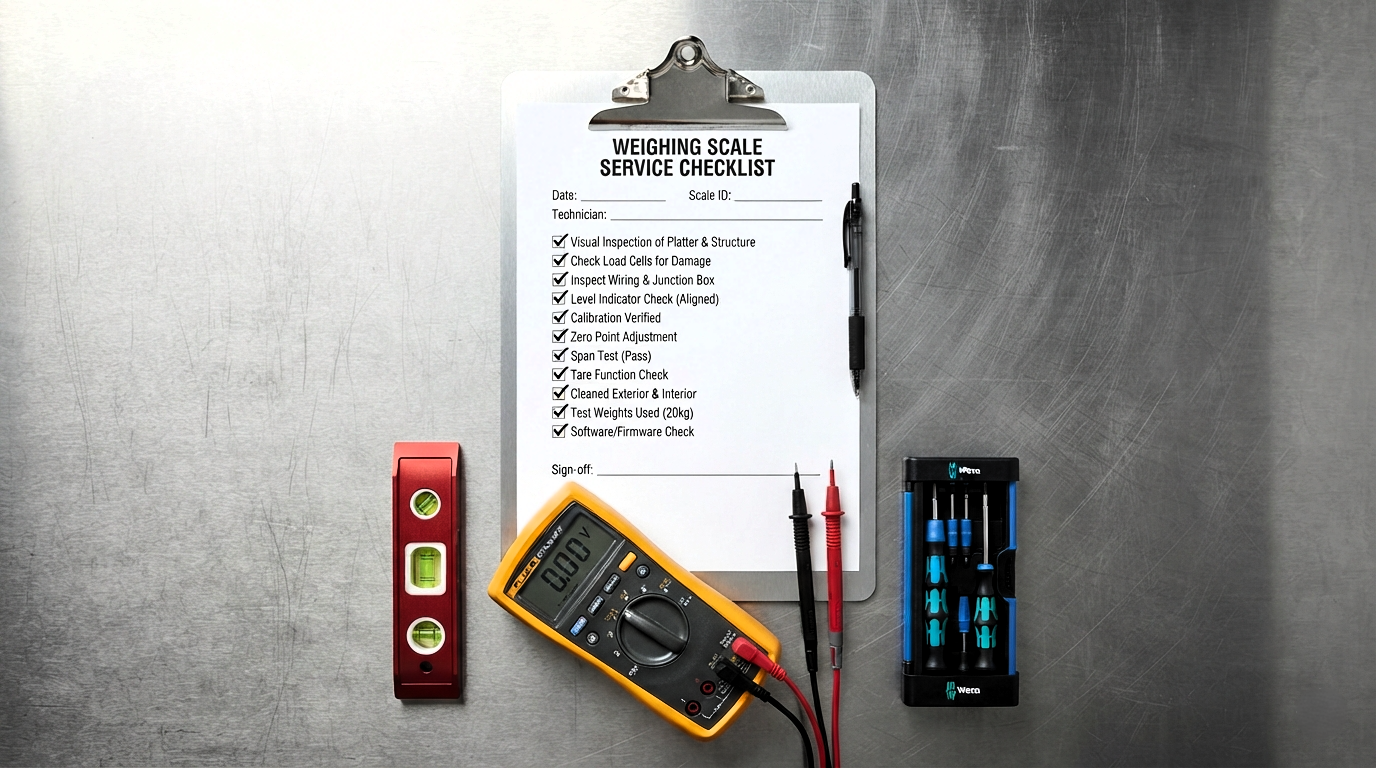
|
Done |
Check |
Notes |
|---|---|---|
|
☐ |
Remove debris from under and around platform |
Look for contact with walls, pipes or frames |
|
☐ |
Check feet, levelling and mounting hardware |
No rocking; hardware tight |
|
☐ |
Inspect load cells for dents, corrosion, cracks |
Note any damaged unit |
|
☐ |
Inspect cables for cuts, kinks, tight pulls |
Drip loops in place |
|
☐ |
Open junction box: look for moisture, rust, loose screws |
Check gasket and glands |
|
☐ |
Check indicator power, battery and earthing |
Use stabiliser or UPS if supply is poor |
|
☐ |
Look for vibration, wind and interference sources |
VFDs, welders, motors, fans |
|
☐ |
Run return-to-zero test |
Record result |
|
☐ |
Run corner test with the same test weight |
Record all five points |
|
☐ |
Run repeatability test (5–10 weighings) |
Record spread |
|
☐ |
Review indicator settings (filter, motion, auto-zero) |
Compare with the manual |
|
☐ |
Check date of last calibration |
Recalibrate with certified weights if overdue |
Repair usually makes sense when the fault is in cabling, a junction box, an indicator, or a single load cell on a sound platform. Replacement is worth discussing when the structure is bent or heavily corroded, several load cells are damaged, or repair costs approach the price of a new unit. A technician can give you a clear repair-versus-replace opinion. You can also explore our range of industrial weighing scales if you need new equipment.
Clean regularly, especially in dusty mills, cotton and grain handling areas.
Protect against heat and monsoon moisture with sealed junction boxes and good cable entry.
Use proper power protection against load shedding and generator spikes.
Never overload or drop loads onto the platform.
Schedule routine service and calibration, at least yearly for most businesses and more often for heavy or trade use.
Keep a simple log of zero, test weight reading and date. Trends show problems before they become failures.
Why is my weighing scale reading unstable?
The usual causes are debris or binding under the platform, loose or damaged cables, moisture in the junction box, vibration or electrical noise, unstable power, or a failing load cell. Work through them in that order.
Why does my scale keep changing weight with nothing on it?
That is zero drift. It can come from moisture, temperature change, low battery, loose wiring or a damaged load cell. If it keeps moving in one direction, the scale needs inspection.
How do I know if a load cell is bad?
Typical signs are drift, failure to return to zero, different corner readings, and jumpy values when the cable is moved. Confirming it needs a meter or load cell tester and the datasheet, so ask a technician.
Can humidity or rain affect a weighing scale?
Yes. Moisture in cables or junction boxes is a leading cause of instability, especially in monsoon season.
Is it safe to keep pressing the zero button?
It hides the symptom but not the cause, and it can mask a developing fault. If you need to re-zero often, get the scale checked.
How often should an industrial scale be serviced?
At least once a year for most uses, and more often in harsh environments or heavy daily use. Check any legal requirements if you weigh for billing.
If you have worked through the checklist and the scale is still misbehaving, the technicians at Libra Weightech can inspect, test and repair it. Book a service visit or request a quote for a replacement. For deeper background on the specs behind accuracy, see our guide on scale capacity vs readability vs accuracy.